

The boot ROM draws the pureikyubu logo
The official IPL is copyrighted and is not shipped. The emulator builds a free replacement
from source instead — the boot animation is emulated ARM code, assembled at run time by the
small emitter in src/gba/gba_armasm.cpp. A rotating wireframe hypercube
collapses into the flat pureikyubu cube mark while the wordmark scrolls in underneath, and
the boot ROM then hands the machine over to the cartridge exactly the way the real BIOS
does.

1. The hypercube turns. Every frame is painted by the boot ROM's own rasterizer.
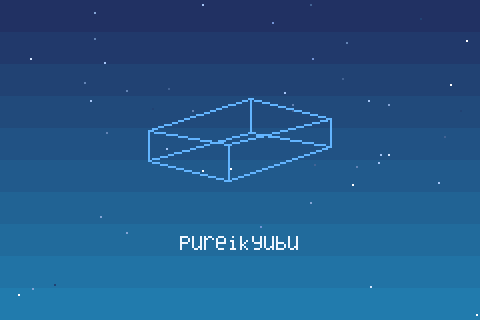
2. The projection collapses and the wireframe settles into the cube mark.

3. The final frame: the cube mark with the wordmark, then the cartridge starts.
The image can be dumped for review, together with its assembly listing:
gba_bench --dump-bootrom bootrom.bin.
Running it
The GBA is a mode of the same executable. A cartridge selects it by its extension, and with no cartridge at all the boot ROM starts its link driver — which is the state the "GBA Link" mode needs.
| Command | What it does |
|---|---|
pureikyubu --gba game.gba | Run a cartridge: boot animation first, then the game. |
pureikyubu --gba | No cartridge: the boot ROM's SIO link driver takes over. |
pureikyubu game.gba | The same as --gba; the extension decides. |
pureikyubu --gba --gba-bios bios.bin | Use a real 16 KByte BIOS image instead of the boot ROM. |
pureikyubu --gba --no-gba-bootrom | Skip the BIOS entirely and start the cartridge directly. |
pureikyubu --gba-link | Initialize the link port even with a cartridge loaded. |
The window, the sound and the input come from SDL2. The keyboard and game controller
bindings, the scale, the sample rate and the link options live in the shipped
build/Data/DefaultGBASettings.json and the user's own
build/Data/GBASettings.json, which is merged over it; a malformed file is
rejected with a message and the built-in defaults are used. The GBA BIOS and the Game Boy
boot ROMs are picked there too, one per machine.
The harness runs a cartridge it assembles itself
The GBA core has no dependency on SDL, OpenGL or ImGui, so it has its own harness
(testing/gba_bench): unit tests, a headless ROM runner, a frame-hash log, PNG
dumps, a speed measurement and a link test that plugs two instances into each other. The
demo cartridge above is assembled at run time by the same emitter the boot ROM uses — a
real ARM program, in a real cartridge image with a real header — so the whole machine (CPU,
cartridge, LCD, timers, VCOUNT synchronisation) is exercised by a single command.
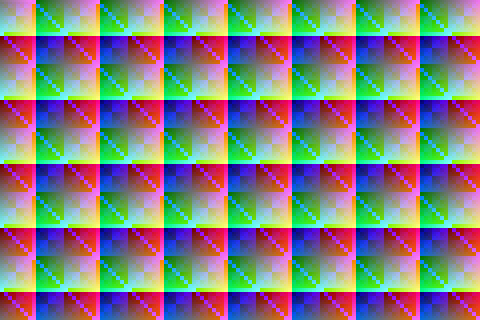
testing/gba_bench/check.sh --demo --frames 120 --png /tmp/demo
testing/gba_bench/check.sh --bootrom --frames 300 --png /tmp/shots
testing/gba_bench/check.sh --run game.gba --frames 600 --bench
The public test ROMs
jsmolka/gba-tests is a suite of MIT-licensed GBA test ROMs. They are not part
of the repository (they are somebody else's build output); a small script fetches them and
the harness runs them like any other cartridge. They are a real end-to-end check, because
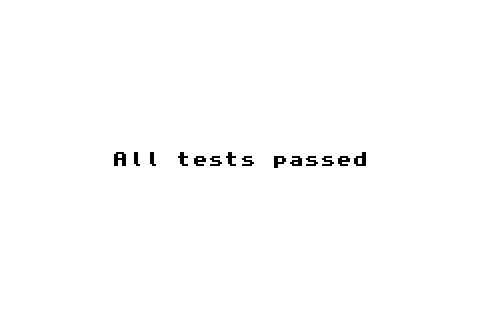
they report their results on screen: the memory, ARM and Thumb suites all report
"All tests passed", and they are what found the VRAM mirroring, the byte-store
rules of the video memory and the register-shift-by-zero carry rule.
testing/gba_bench/get_test_roms.sh
testing/gba_bench/check.sh --run testing/gba_bench/roms/memory.gba --frames 200
testing/gba_bench/check.sh --run testing/gba_bench/roms/arm.gba --frames 200
The Game Boy mode
The GBA can run Game Boy cartridges only because the console carries a second, older
machine inside it. That machine is implemented as its own core as well
(src/gba/gb_*.cpp): the LR35902 CPU, the DMG/CGB LCD with the CGB palettes and
VRAM banks, the four sound channels, and the MBC1/2/3/5 mappers with battery saves. It has
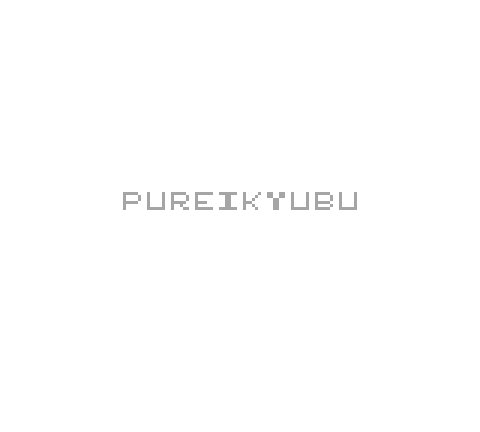
its own free 256-byte boot ROM, whose boot animation is the "pureikyubu" wordmark sliding
into the middle of the screen.
What is implemented, and what is not
Implemented
The ARM7TDMI (ARM and Thumb, all seven modes, the exceptions, HALT), the memory map with the open bus and the WAITCNT waitstates, the LCD (tile modes 0-2, bitmap modes 3-5, sprites, windows, mosaic, blending, forced blank), the four timers, the four DMA channels including the sound-FIFO and video-capture timings, the keypad, the interrupt controller, the sound (the four legacy channels and the two direct-sound FIFOs), the serial port in normal/multiplayer/UART mode with an emulated link cable, the cartridge (ROM-only plus SRAM, Flash and EEPROM saves, the GPIO/RTC port), the BIOS calls in the host, and the emulator's own boot ROM with its SIO link driver.
Not implemented (yet)
The JOY bus (a GameCube controller on the link port) and the Game Boy Player's own boot protocol; the BIOS sound driver and the Huffman decompressor; save states and rewind; the EEPROM's "last byte is the AND of the old and the new value" quirk. The LCD composes a scanline when its HBlank starts rather than dot by dot, and the internal RAM's own access times are not modelled. The full list, including every deliberate deviation the tests pin down, is in testing/gba_bench/Readme.md.
Documentation
Wiki: GBA
How the machine is put together: the boot ROM, the link port, the settings, the tests and the deviations.
The core's own notes
src/gba/Readme.md: the file layout, the specifications each file is written from, and how a frame runs.
The test harness
testing/gba_bench: what the tests cover and which hardware behaviours are deliberately simplified.
Credits
The purple Game Boy Advance in the page icon is
Evan-Amos'
photograph (public domain, via Wikimedia Commons), cropped and keyed by
src/res/make_gba_icon.py; the icon itself is src/res/gba_icon.png.
